Customize the building blocks for a sequential reviewer workflow template
Inspire provides a template for a content review process involving two users. If you want a workflow with more options for configuring activities and their transitions, you can update the workflow template. The template is used to create an active workflow and to tell Inspire how to automate the workflow you need.
 Required permissions
You must have permission to the Projects Module to work with projects and workflows. Other than that, you do not need special permissions to create, edit, or delete workflow templates.
 However, keep in mind that administrators and other users can set permissions on components and folders.
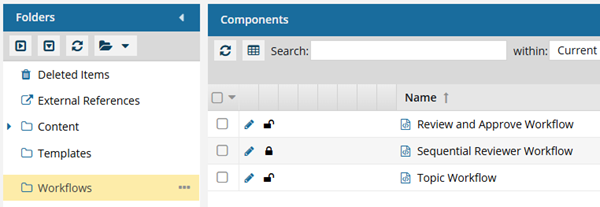
- You must have permission to edit the workflow template component.
- You must have folder permissions where the template is stored.
- For details on how to check and set permissions, refer to: Set permissions
 For a complete list of permissions, including starting a workflow from a template, read: Workflow permissions.

 Tips and tricks
- You can create an entirely new workflow template component that has no default Activities and Transitions.
- Use the Topic workflow template explained in this topic as an example of what you can create.
- To create a new template, follow the steps in: Create a workflow template component.
- If you aren't sure what specific options you might need before creating a workflow, you can add new ones at any time.
- For Activity configurations, you should build the options you need for Status, Project Activity, and Workgroup.
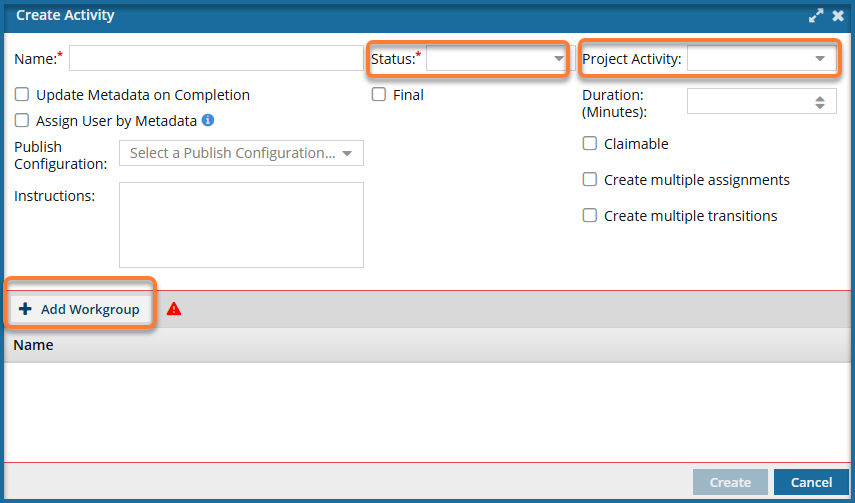
- Status. You track the progress of a content development Activity by assigning it a Status. By default, Inspire includes the following statuses: Writing, Reviewing, and Publishing. You can customize this list.
- After you use the workflow editor to create a new Status or update an existing one, that status is unique to the template you're working in. If you want to use the new or updated Status in another template, you have to re-create it in that specific template.
- To create or update a Status in a template or for an Activity, follow the steps in:
- Project Activities. Every project assignment and workflow activity must be associated with a category that defines the work. By default, Inspire includes the following categories for Project Activity: Approve Content, Edit Content, Publish Content, Review Content, Review Image, and Write Content.Project Activity is a required field and cannot be left blank. Although this field is not marked with a red asterisks, and you can create a new Activity without selecting a Project Activity, if you leave it blank, the Save and Submit options are not available until you correct the errors in the workflow template.
- If there is an error in the configuration of the Activity, you see the Activity name in red.
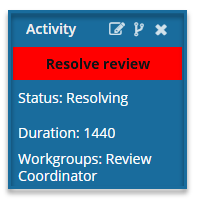
- Project Activities are configured by Administrators outside the workflow editor.
- After a project activity is created or updated, it can be used across all templates.
- If you are an administrator, follow the steps in: Manage project activity configurations.
- If there is an error in the configuration of the Activity, you see the Activity name in red.
- Workgroups. You must have a list of users who can complete the work for a project Activity. For example, if the activity is a legal review, you would create a workgroup that includes your company lawyers.
- After you use the workflow editor to create a new Workgroup or update an existing one, that group is unique to the template you're working in.
- If you want to use the new or updated Workgroup in another template, you have to re-create it in that specific template.
- To add or remove users in the Workgroups or create new groups, follow the steps in:
- Status. You track the progress of a content development Activity by assigning it a Status. By default, Inspire includes the following statuses: Writing, Reviewing, and Publishing. You can customize this list.
- For Transition configurations, you should build the options you need for an Action.
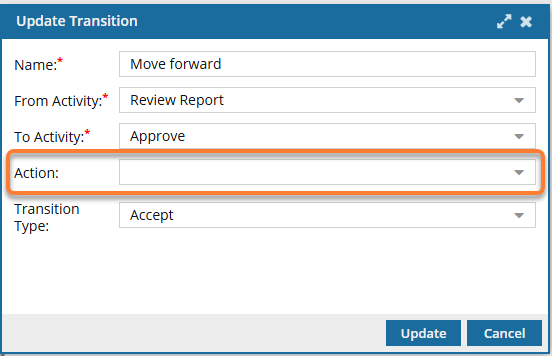
- You use Transitions to identify what should happen when a workflow Activity is completed. For example, after a technical review, you can create a transition that specifies the files should go to an editor for review.
- You can create a Transition from an Activity or by copying and pasting an existing one and then editing it.
- If the activity chosen in From Activity is configured for multiple transitions, you must select a Transition Type. Otherwise, this option is grayed out and unavailable.
- If there is also an Action that needs to be done, such as Take a snapshot, you can create the Action and then add it to the appropriate Transition.
- Actions are normally completed by the user who is advancing the workflow by marking a task as Completed.
- After you open a template and create a new Action or update an existing one, that Action is unique to the template you're working in.
- If you want to use the new or updated Action in another template, you have to re-create it in that specific template.
- There are various system actions you can add that Inspire recognizes, however they must be created in a Topic workflow or in a completely new workflow component. They cannot be used in a sequential reviewer template.
- These actions change what the user sees when they complete an Activity.
- The action can be completed only by Inspire, such as automatically approving components associated with the workflow Activity.
- The action can also be started by Inspire and completed by the user. For example, Inspire can open the Create Review screen for the user and prepopulate it with any known information. The user must add any missing information and click Create.
- For more information, read: Automate content development with a workflow template.
- You can manage actions for a sequential reviewer workflow in the following ways:
- You use Transitions to identify what should happen when a workflow Activity is completed. For example, after a technical review, you can create a transition that specifies the files should go to an editor for review.