Manage projects
As your project progresses through its life cycle, you can update its content and state.
A project is a collection of related components, participants, and assignments you need to complete a specific goal. As work progresses, you can make changes to the components, participants, and assignments associated with a project. When the work is done, you can update the project's state to Completed, and then delete it if necessary. Only the project owner and individuals with permission can make changes to a project.

 You must have permission to the Projects Module to work with projects.
- By default, only users with the following permissions can create project workflows and assignments:
- Administrator permissions
- Access to the Project Module with the Create permission
- Even if you don't have these permissions, you can be granted a special permission to create workflows and project assignments after a project is created.
- If you are an administrator, refer to Allow users to create project assignments and workflows.
 Tips and tricks
- For help starting a project, read Get started with projects.
- The Content pane shows you icons about a component's properties:
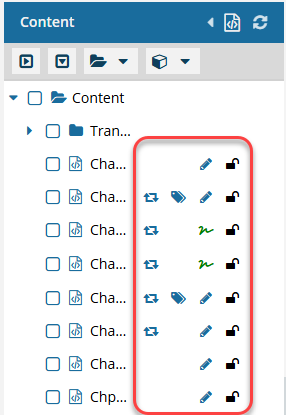
- Shared (
 ). The seventh column tells you the number of references in Inspire. To see the number, hover your cursor over the icon. All references are counted, even if one component references this component multiple times.
 - Tags (
 ). The eighth column tells you if at least one component tag has been added to a component's Inspire-based metadata. To see a list of all tags applied, hover your cursor over the tag icon.
 - State (
 ,
, 
 ,
,  ,
,  ). The first column lets you quickly identify appropriate actions you can take on a file.
 - Draft. The component can be edited and isn't ready for publishing or translation yet.
- Invalid. The component has one or more links that need to be resolved. Use the advanced Relationships tool as described in: Repair component relationships.
- Approved (No signature required). The component is ready for publishing or translation and shouldn't be edited. An Inspire user has approved the component for publishing or translation and it shouldn't be changed. Approved components can be locked with a green system lock.
- Approved and signed. (Signature required). The component is ready for publishing or translation and shouldn't be edited. When approving, you are required to enter your full name to attach an electronic signature. Approved components can be locked with a green system lock.
- In translation. The component can be monitored while it's included in a translation job. An administrator can decide if the component is unlocked for editing while in translation.
- Lock (
 ,
,  ,
,  ,
,  ,
,  ). The second column tells you if anyone else is using the file currently and if you can edit it.
- Unlocked. The component isn't being edited by another user or in use by Inspire.
- Locked by another user. Another user has opened this component and made changes that may have been saved but not submitted yet.
- Locked by you. You have opened this component and made changes that may have been saved but not submitted yet.
- Locked by Inspire. Inspire prevents other users from editing the component while it's being processed. This can include the process of reviewing, for example.
- Locked after approval. A component has been approved, and an administrator has configured components to be locked upon approval.
- Shared (
- If you need to see more of the component name or use an advanced search to find the components you want to manage, you can open the
 Select Project Components screen.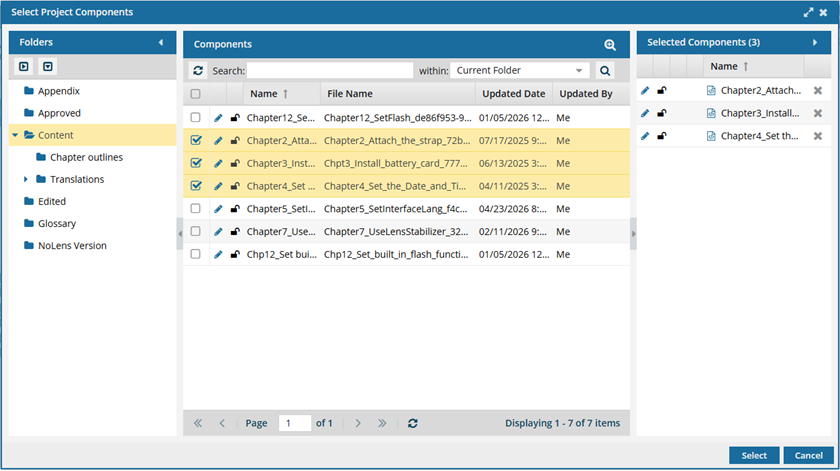
Selecting components adds them to the Selected Components panel. Follow the steps in: Select project components.
- If you want to see all assignments across all projects, you can now use the Workflows module instead of opening each project separately.
 View workflow assignments.
 - If you want to see all the components referenced in your project map, you can run a Map asset report. View a map asset report for a project component.
- You can select an option to use a global overdue notification configuration. This allows you to configure overdue notification settings once and apply the settings to all project work and reviews. Understand the new Global overdue notification setting
 A project assignment can be given a State of Ready to Claim. In this scenario, no specific user is assigned to complete the work. Instead, a list of possible users is identified and they are all notified that the assignment can be claimed. The first user to claim the assignment by setting the State to In Progress can complete the work. This option to make an assignment Claimable is available when working with project assignments and workflow activities. For more details, read:
 To remove or update a project it must be active. If you cannot access an option in the steps, make sure the project is active. Follow the steps in: Make a completed project active.