Use assignment cycles
Project owners or administrators can create an assignment to provide details about a task that needs to be completed and notify the assignee. As work progresses, the user who created the assignment may want to monitor its progress, update the assignment details, or cancel the assignment and initiate a workflow instead. Users who are notified about the new assignment can claim it, start on the work, and mark it as complete. After an assignment has been completed or cancelled, a project owner or administrator can remove it if necessary.

 Tips and tricks
Project owners, coordinators, and participants can update the State of an assignment.
- The actions you can take on an assignment depend on what State the assignment is in and your project permissions.
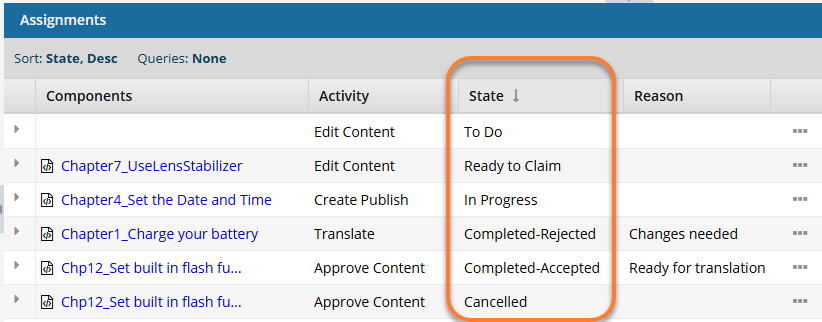
Assignments move through States in the following order:
- Assignment creation. When a project coordinator, administrator, or user with special permissions creates an assignment, they can either assign the work to a single user or create a list of users to possibly do the work.
- The To Do State. This state is set only when the assignment has been given to a specific user.
- The Ready to Claim State. This state is set only when the Assigned To field is left blank, and the State is manually set to Ready to Claim. The assignment must be created with a list of users on the Claim Assignment tab.
- The assignment is ready to be worked on. After an assignment is created, a user must accept it by setting the State to Start or by claiming it.
- The In Progress State. This state is set after an assignee selects Start, or a user who can claim an assignment selects Claim. After an assignment is claimed, Inspire sets the State to In Progress.
- The work has been done or was re-evaluated. The result of work done on an assignment is either the completion of the work or the need to stop and create a different assignment.
- Completed. When a user selects this State, the assignment is considered finished, and no further changes can be made to its details. This state can be selected at any time in an assignment's life.
- Canceled. When a user selects this State, all work is stopped, and the assignee receives a notification. No other changes can be made to the assignment details.
 In any state, you can stop the workflow. If you are an administrator, project owner, or the user who started the workflow, you can select Cancel to set the state to Canceled and stop the workflow.
Assignments connected with workflows cannot be canceled. Only single assignments (not used in a workflow) can be canceled from the Assignments pane.
- The assignment no longer needs to be retained. If the assignment has been finished for longer than the period of time required for audits or retention policies, you can Remove the assignment record completely.
 You can skip states and return to a previous state.
- You can start an assignment with a State of To Do, and then update it to Completed (skipping the State of In Progress).
- You can also revert to an earlier stage only if the assignment is not connected to a workflow. For example, you can change an assignment with a State of Completed back to In Progress if you need to do more work.
- You can move from the Canceled State back to any other State.
- Updating a State to the next step can be done by any project participant, coordinator, or owner.
- Reverting to an earlier state or undoing a State can only be performed by a project owner.