Create a translation completeness report for one component
You can get a written account of a component's translation status by creating a Translation Completeness report. The report tells you which languages the component has been translated into, whether the translated components in the language subfolders are locked, and whether it has branches.
 Tips and tricks
- You don't have to be a translation coordinator to generate a Translation Completeness report.
- You can run the report on one or multiple components. You can also select a map component to check the translation status of each referenced component.
 If you select multiple components at once:
 - All reports will use the same report options.
You will generate a separate report for each component.
 If you want to select different report options for different components, generate one report on one component at a time.
 - If the TranslationLockSourceDisabled feature is set to true, then a source component can be edited while translation is in progress.
- If changes were made, when you run a Translation completeness report for the source, you see a status telling you that the translation is out of date.
- This new status identifies that the translation doesn't have the same content as the source and should be translated again if necessary.
- You can access the report option in the Components browser from:
- The right-click or
 Options menu
  The Selected Components pane.
  Create a translation completeness report for multiple components
- The right-click or
- You can configure what is in the report, including:
- Target languages
- Images
- Branches
- You can access the report from your email or the Notifications tab.

To create a completeness report on a translated component:
-
From the top menu, select
 Components.
-
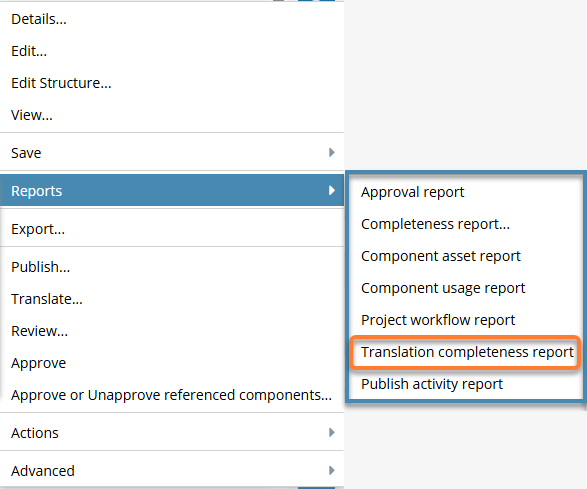
To quickly create a report for one translated component:
-
Right-click the component (or use the Options menu).
- Select Reports, and then select Translation Completeness Report.
-
Right-click the component (or use the
-
To use the Selected Components panel:
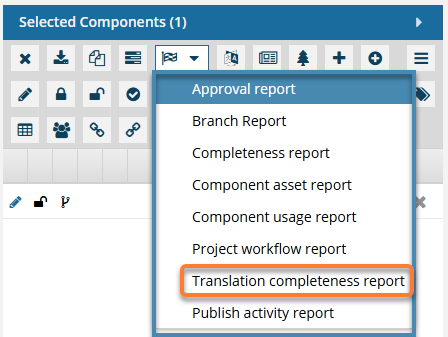
- Select the checkbox for the component you want to create a report for.
-
On the toolbar, select
 Reports, and then select Translation Completeness Report.
-
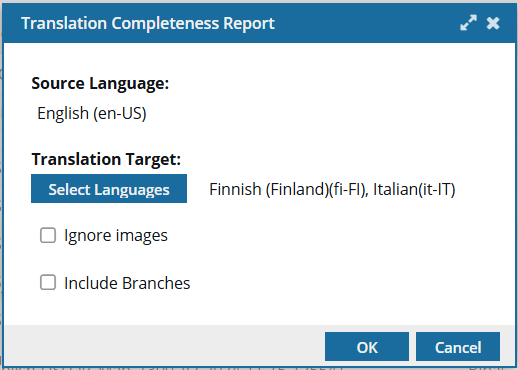
On the Translation Completeness Report screen:
-
In Translation Target, all languages that the component has been translated into are listed. To identify which languages you want to include in the report, click Select Languages and select the checkbox for any language you want to include.
Critical notes:
- If you just created a translation completeness report, the next one may list the languages from the previous report's component. You can reset the Select Languages value by clearing your cache.
- Not all Target languages are listed by default if you run the report from the Selected Components panel.
-
Click OK.
 Results:
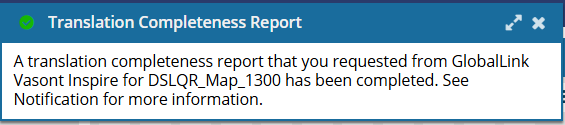
You see two notifications, one telling you the process has begun, and one when the process completes.

-
In Translation Target, all languages that the component has been translated into are listed. To identify which languages you want to include in the report, click Select Languages and select the checkbox for any language you want to include.
-
In the top menu, click
 Notifications.
-
From the list of notifications, select one that says Translation Completeness Report.
Results: You see a report similar to the following:
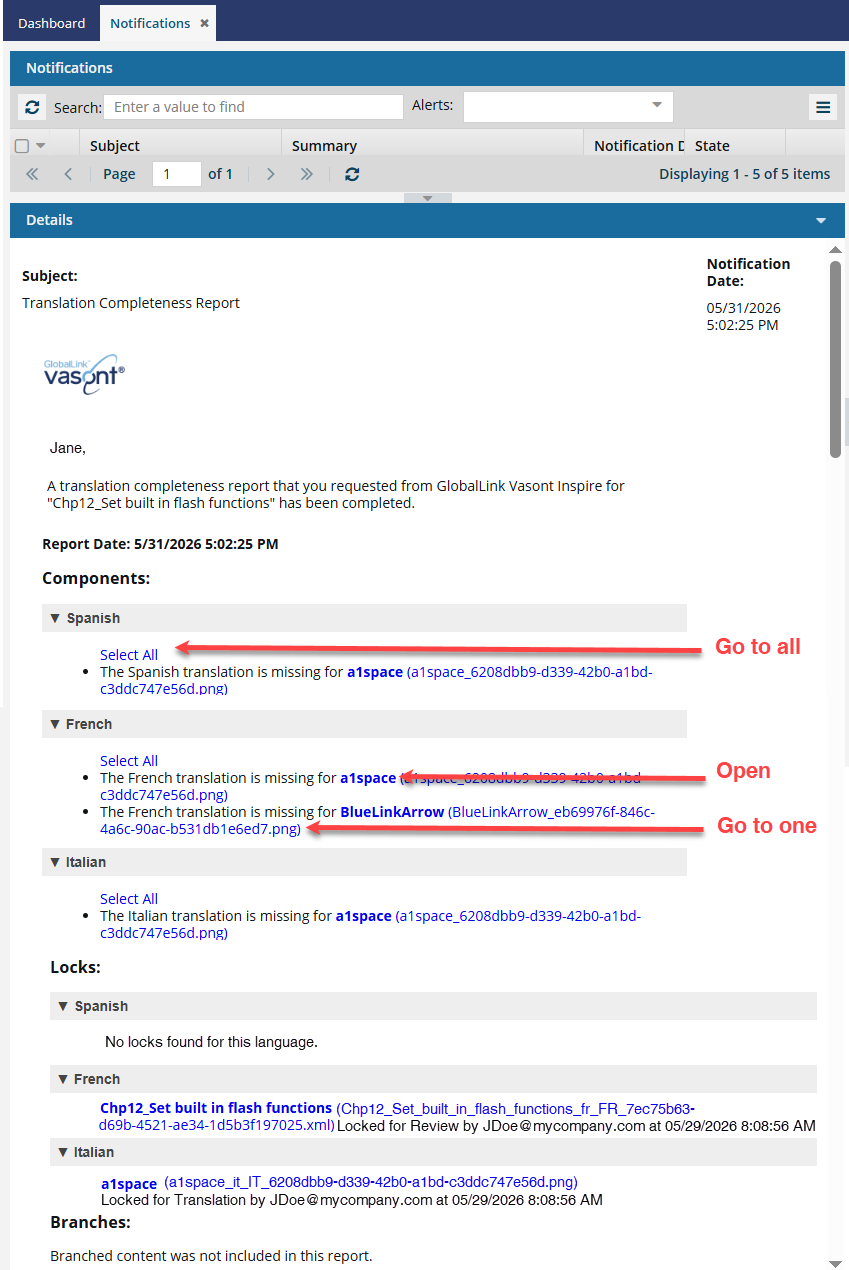
You can click any of the following types of link:
- Select All. Click this link to open the folder containing all the components listed in a section of the report.
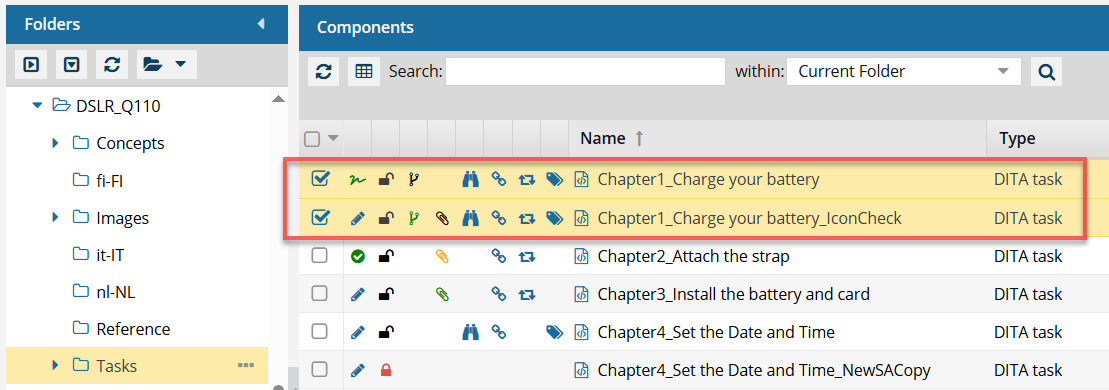
- If you click this link from an email, a browser tab opens, and Inspire opens to the Components browser.
- If you click this link from a notification inside Inspire, the Components browser opens.
- In the browser, you see all the components highlighted from that section of the report.
- If the components are in different folders, you see the items from the first folder listed in the Folders pane.
- The components are also listed in the Selected Components pane.
- Open one. If the component's content needs to be updated, click the component's Name to open it in the Oxygen editor.
- The Name is listed first.
- The Name does not contain the file extension. For example, "Chapter1_Charge your battery_IconCheck".
- If the component is locked or a binary, you see the component in a read-only viewer.
- Go to one. If you need to update a component using a system function, such as Rename, you can click on the File Name, which is a link that opens the folder where it's stored.
- The File Name is listed second, after the shorter Name and in parenthesis ().
- The File Name contains the file extension. For example, "Chapter1_Charge_your_battery_IconCheck_070e9999-fe40-4747-b57d-ba1096b925ed.xml".
- Select All. Click this link to open the folder containing all the components listed in a section of the report.